
Bastrop County Criminal Court Cases
Bastrop County criminal court cases are divided by jurisdiction. Felonies are filed with the District Clerk and heard in district courts, including the 21st, 335th, 423rd, and 465th District Courts. The docket should confirm the assigned court because a civil rotation does not settle the criminal assignment. Class A and B misdemeanor cases generally belong to the County Court at Law, whose records pass through the County Clerk. Fine-only cases can remain with one of four justice courts or a city municipal court.
The clerk is the court file custodian. That file begins to develop after a prosecutor files a complaint, information, or indictment. It differs from a sheriff booking record created at intake and from the public Texas DPS conviction search. The Bastrop County case file may show a pending or dismissed prosecution that never appears in the public DPS product. When the desired record is a plea, motion, judgment, sentence, or certified disposition, ask the clerk serving the court shown on the docket.
Routing Bastrop County Court Records
Offense level points to the right records counter. The District Clerk can be reached at 512-332-7244, while the County Clerk is at 512-332-7234 and the County Court at Law at 512-581-4277. Justice courts maintain their own fine-only files, warrants, and magistrate records. A municipal charge stays with the city court unless a separate county prosecution is filed.
| Venue | Typical record | Contact |
|---|---|---|
| District courts | Felony proceedings and district criminal files | District Clerk, 512-332-7244 |
| County Court at Law | Class A and B misdemeanor matters | 512-581-4277 |
| Justice Court Precinct 1 | Fine-only cases, warrants, and magistrate work | 803 Pine Street, 512-581-4258 |
| Municipal courts | City ordinance and fine-only state-law cases | Contact the city court named on the citation |
The county court directory should be checked before travel because offices occupy more than one downtown building. Exact court and case number are more useful than a general request for a criminal record.
Searching Bastrop County Case Records
Bastrop County Odyssey Public Access is the first local index. Select Criminal Case Records rather than Civil, Family & Probate or Court Calendar. An exact citation or case number reduces false matches. JP1 directs users to search a citation exactly as printed, open the blue case number, and review case details. If that fails, Defendant plus date of birth is the documented fallback.
- Choose Criminal Case Records on the Odyssey location screen.
- Set Search By to Citation and enter the citation exactly.
- Open the blue case number to read the docket and charge entries.
- If no result appears, search Defendant using Party Information and date of birth, then retry weekly when an officer has not filed yet.
- Request a plain or certified document from the clerk when Odyssey shows an entry but no usable image.
| Field | Type | Required | Use |
|---|---|---|---|
| Select a location | Dropdown | Yes | Choose Criminal Case Records |
| Search By | Dropdown | Yes | Citation or Defendant are confirmed options |
| Citation | Text | Conditional | Enter it exactly as printed |
| Party Information | Text group | Conditional | Defendant-search fallback |
| Date of Birth | Date or text | Optional | Narrows the defendant result |
The official JP1 search directions show this local sequence. The captured guide below makes the exact-citation-first rule easy to recognize.
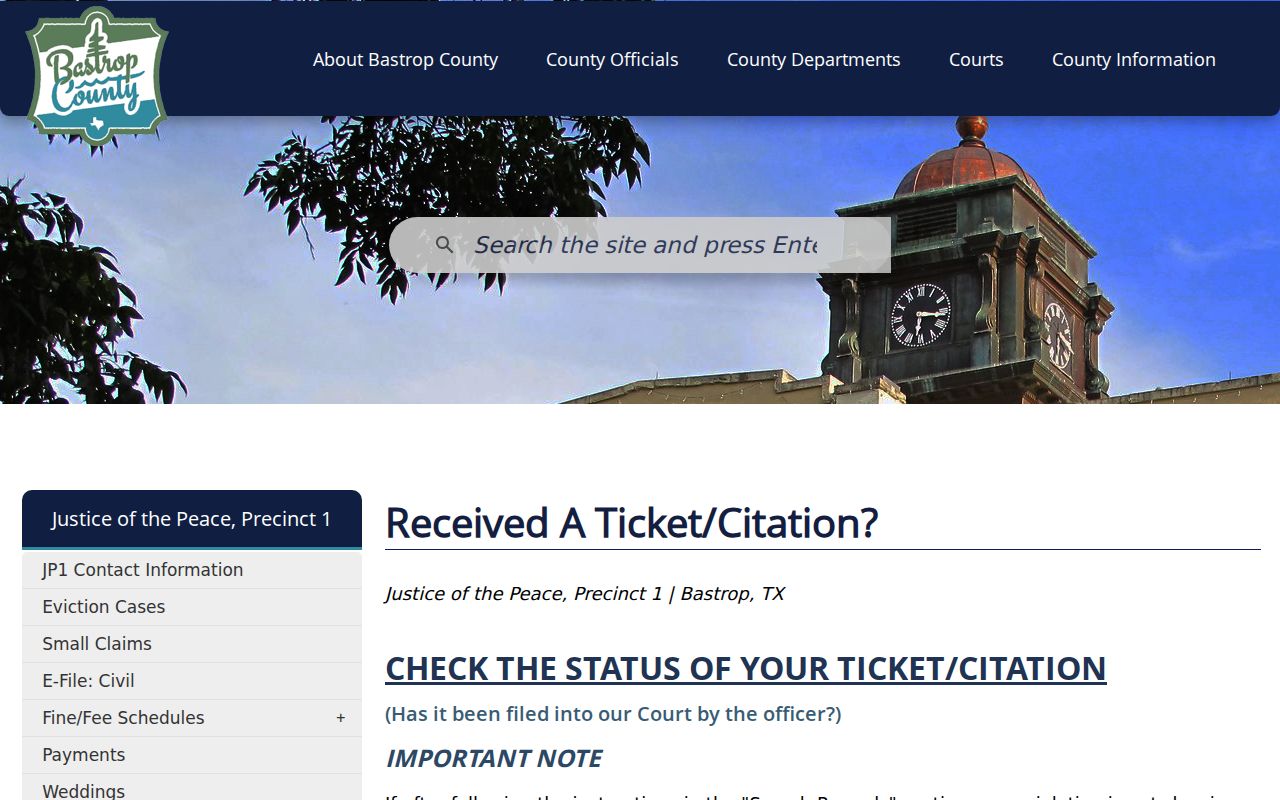
That workflow prevents a blank first search from being mistaken for proof that no Bastrop County court case exists.
Bastrop County Court Entry Rules
A record search may lead to a hearing or a counter visit. JP1 publishes its courtroom rules, including silent phones, calls taken outside, no food or drink, and restrictions on hats, disruptive talk, and dress. Those instructions belong to JP1 and should not be treated as a universal policy for every Bastrop County court.
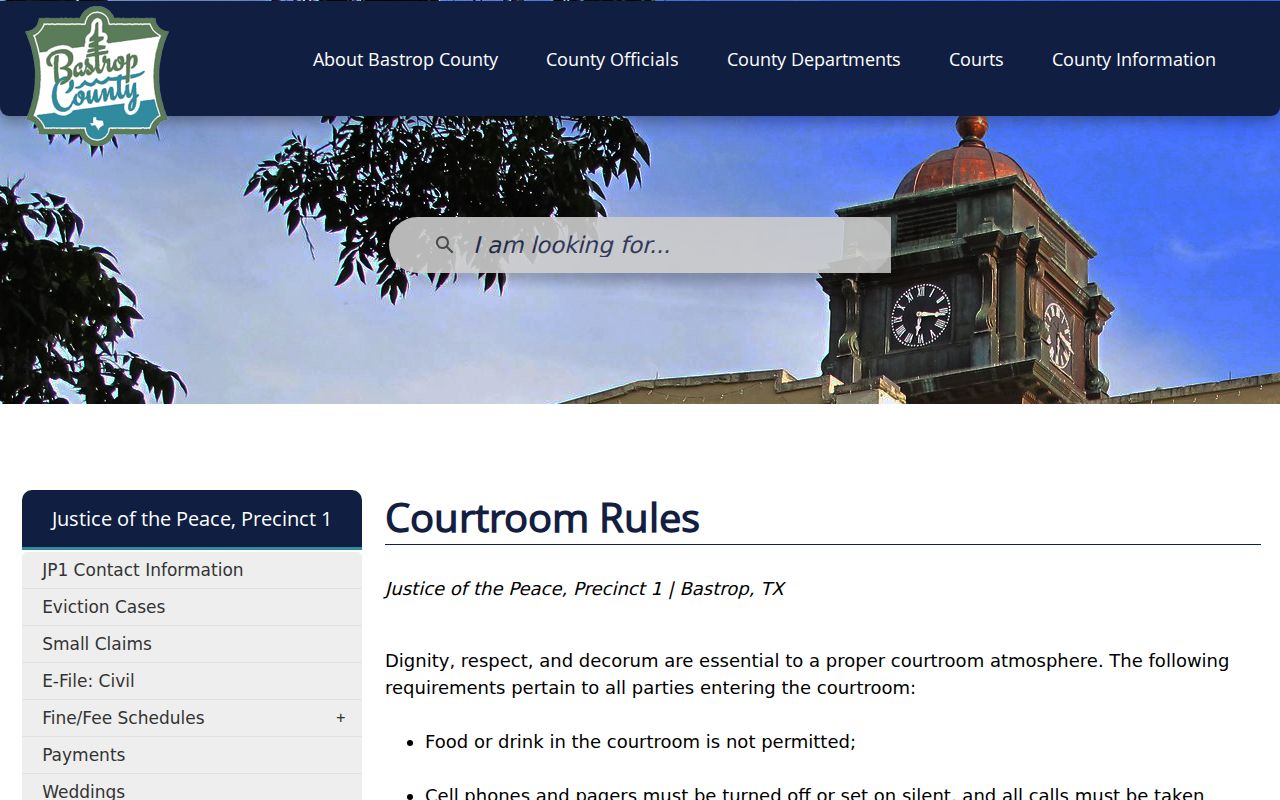
The image reinforces why a reader should check the destination court's current security, device, access, and recording policies before arriving.
JP1 is at 803 Pine Street on the third floor and lists weekday hours from 8:00 a.m. to 4:00 p.m. It also identifies English language access during normal hours and Spanish coverage from 8:00 a.m. to 3:00 p.m. These are useful, court-specific facts. Other clerks may use different counters or schedules.
Inside a Bastrop County Case File
A Bastrop County criminal case file records procedural steps rather than just an arrest. Public details commonly identify the court, case number, filing date, status, charges, docket events, and disposition. Some pleadings or judgments may not be imaged online. Document access and cost vary, so the clerk remains the source for a complete or certified copy.
| Case Number and Court | Identifies the file and the clerk responsible for it. |
|---|---|
| Charging Document | A complaint, information, or indictment stating the filed accusation. |
| Docket Entries | A dated list of filings, hearings, pleas, rulings, and later compliance events. |
| Hearing Dates | Settings for arraignment, pretrial work, plea, trial, or sentencing. |
| Disposition and Judgment | The outcome of each charge, which may include dismissal, acquittal, deferred adjudication, or conviction. |
| Sentence and Conditions | The court's punishment and any supervision, fine, restitution, or other terms shown in the public file. |
Read each charge on its own. A single Bastrop County case can contain a dismissed count beside a count resolved by plea or trial.
Bastrop Court File or DPS Record
The Texas DPS Criminal History Name Search is not a substitute for the local docket. It shows the public Texas conviction and deferred-adjudication subset reported to the Computerized Criminal History system. It requires an account and prepaid credits, with one $1 credit used per search. A name match is not fingerprint confirmation.
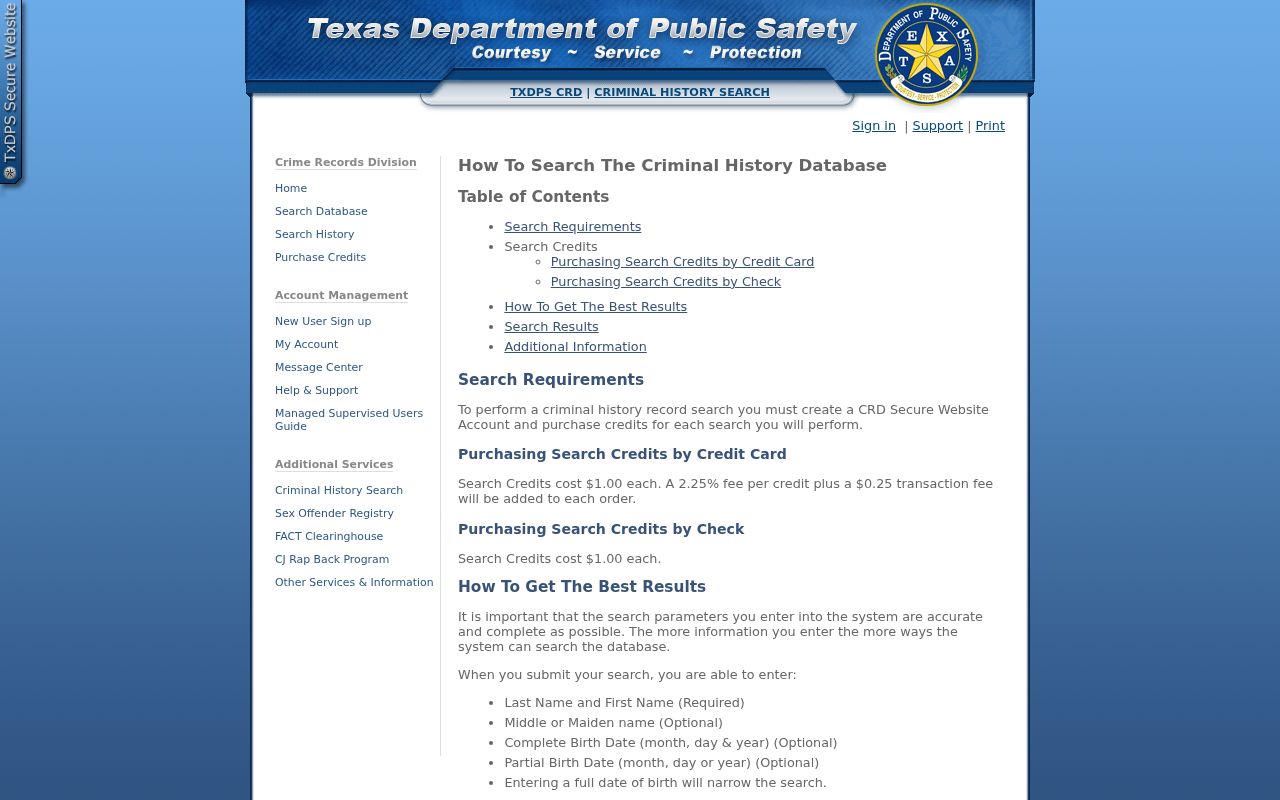
The screen helps separate a statewide public history search from a Bastrop County docket search. A pending filing, dismissal, or recent local event may be visible in Odyssey before it reaches, or without becoming part of, the public DPS result.
For one's own identity-confirmed Texas record, DPS directs people to fingerprint review through FAST and IdentoGO. When the question is what a Bastrop County judge ordered, however, the signed court document and clerk certification carry the needed detail.
How a Criminal Case Moves
A Bastrop County arrest normally leads to booking and a magistrate appearance without unnecessary delay and no later than 48 hours under the county's published Fair Defense Act rules. Prosecutors then decide whether and how to file. A felony commonly proceeds from complaint to grand-jury review and indictment. A misdemeanor is often charged by information.
Case flow: Charges Filed › Arraignment › Pretrial › Plea or Trial › Disposition › Sentencing
Arraignment addresses the charge and plea. Pretrial entries may record settings, motions, discovery issues, or resets. A plea or trial produces a disposition, meaning the result for that charge. Sentencing follows a conviction or other adjudication that calls for an order. An appeal can create a separate appellate record. Odyssey may list an event before the related image is available.
When Bastrop Case Data Is Wrong
First compare Odyssey with the actual clerk file. Older, non-imaged, sealed, or restricted records may require a direct inquiry. Give the clerk the party name, approximate year, court, case number if known, and the exact document sought. re:SearchTX can supplement the local search for participating Texas courts, but registration is required and participation, documents, and charges vary.
If an error has reached the Texas CCH record, the DPS Error Resolution process calls for a fingerprint-based personal review and certified court documents supporting the correction. A screenshot of that official route appears below.
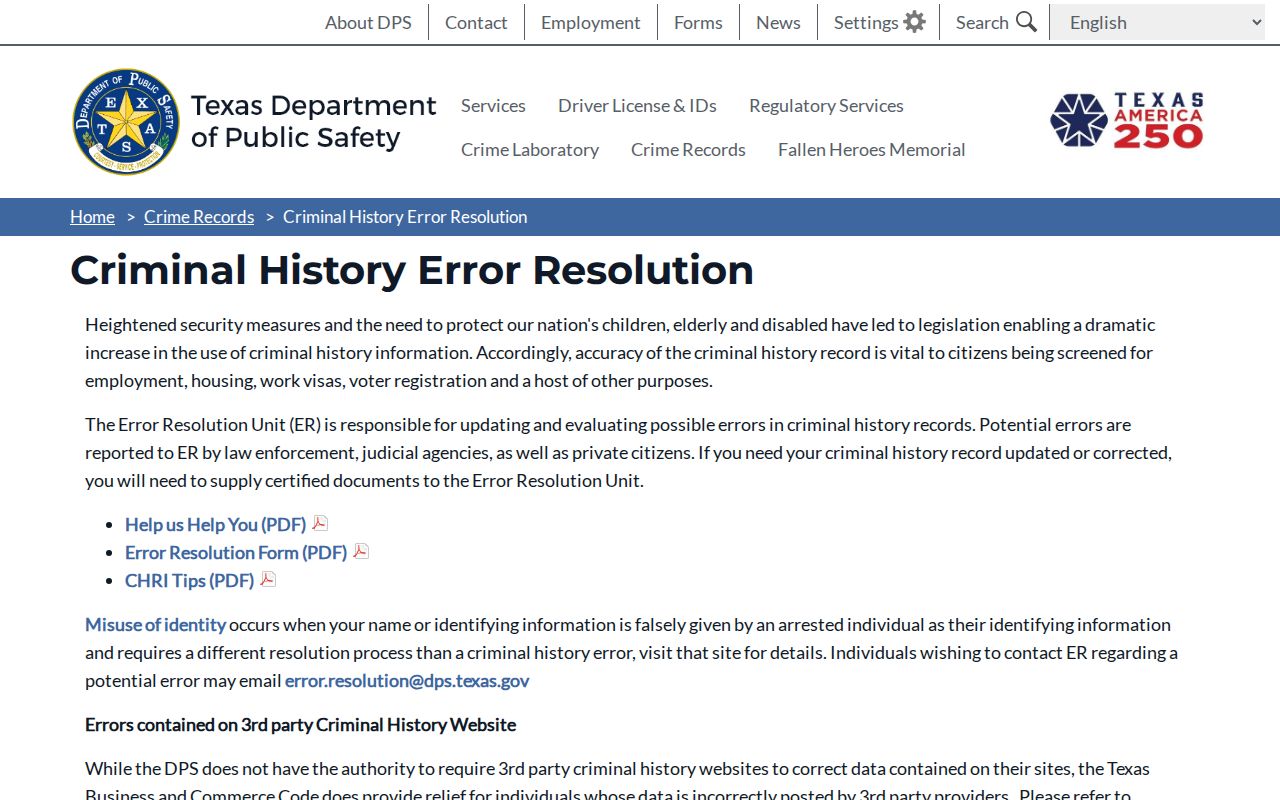
This two-source check matters because the local clerk corrects the court file, while DPS handles the state repository record.
Bastrop Court Settings and Resets
Bastrop County's January 2025 district rules add local consequences to docket entries. The sheriff or arresting agency provides a Notice of Court Setting at arrest or bond release. Reset forms require signatures, and failure to follow a setting can have bond-forfeiture consequences. Trial settings cannot simply be passed by agreement alone. These rules explain why the docket's setting and reset entries deserve close attention.
- Arraignment
- The stage at which charges and a plea are addressed.
- Reset
- A signed change to a scheduled court setting.
- Disposition
- The outcome recorded for a charge or case.
- Capias
- A court order directing arrest, often tied to a missed or failed procedural duty.
A phone call does not replace the signed docket order. Confirm the current date and attendance terms with counsel or the responsible clerk.
Case Record Access and Restrictions
Texas court records are generally open through the responsible clerk, subject to sealing law, statutes, and redaction rules. The Texas Public Information Act also governs public information held by government offices, but a request does not override rules that protect juvenile files, sensitive victim or minor data, Social Security numbers, financial accounts, and other confidential identifiers.
Expunction under Code of Criminal Procedure Chapter 55A can remove qualifying arrest and related records as an order directs. Nondisclosure under Government Code Chapter 411 restricts ordinary public dissemination but does not erase the file for all authorized users. A sealed, expunged, or nondisclosed Bastrop County case may therefore be absent or limited in a public search.
When an expected case does not appear, do not assume it never existed. Confirm the court, offense level, filing status, and record restriction before drawing a conclusion.