
Checking Criminal History in Smithville
Smithville criminal records begin with a written police request or a Municipal Court inquiry, depending on who made the file. Police reports describe incidents and arrests. Court files record city citations and their outcomes. County and state sources become useful only when custody, prosecution, or CCH reporting moves beyond Smithville.
- Write to Smithville Police with your contact details and a clear description of the record.
- Send it by records email, mail, in person, or fax marked for the police custodian.
- Contact Smithville Municipal Court for a city citation and its filed result.
- Move to Bastrop County sources for booking or a higher-level criminal case.
- Use Texas DPS for the public statewide subset or FAST fingerprints for your own full review.
Smithville Requests Must Be Written
Smithville Police instructions state that a phone request is not accepted. The writing must include the requester's name, contact information, and a clear description. Send it through the records email link, by mail, in person at 317 Main, or by fax to 512-237-4549 marked Open Records for the police custodian.
The official instruction screen shows those channels and their limits.
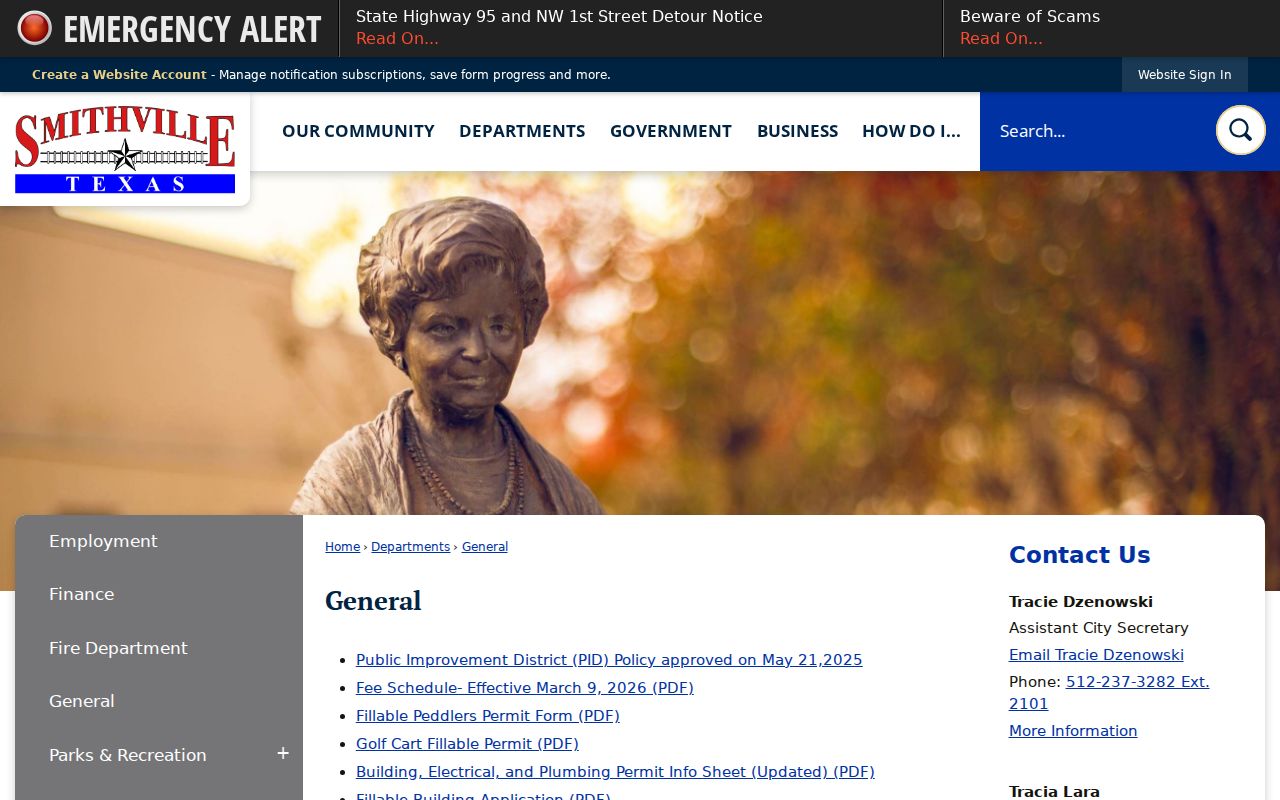
An optional fillable form is available, but the research found no posted police copy fee, ID rule, or fixed turnaround. Do not assume terms Smithville has not published.
Keep proof of submission, especially when using fax or mail. If the custodian needs a narrower date range or a clearer description, respond with facts that identify the same Smithville record. Do not turn the clarification into a demand for Smithville to analyze events or answer legal questions. A request for an incident report, arrest report, call record, or named document is easier to process than a request asking what happened in general.
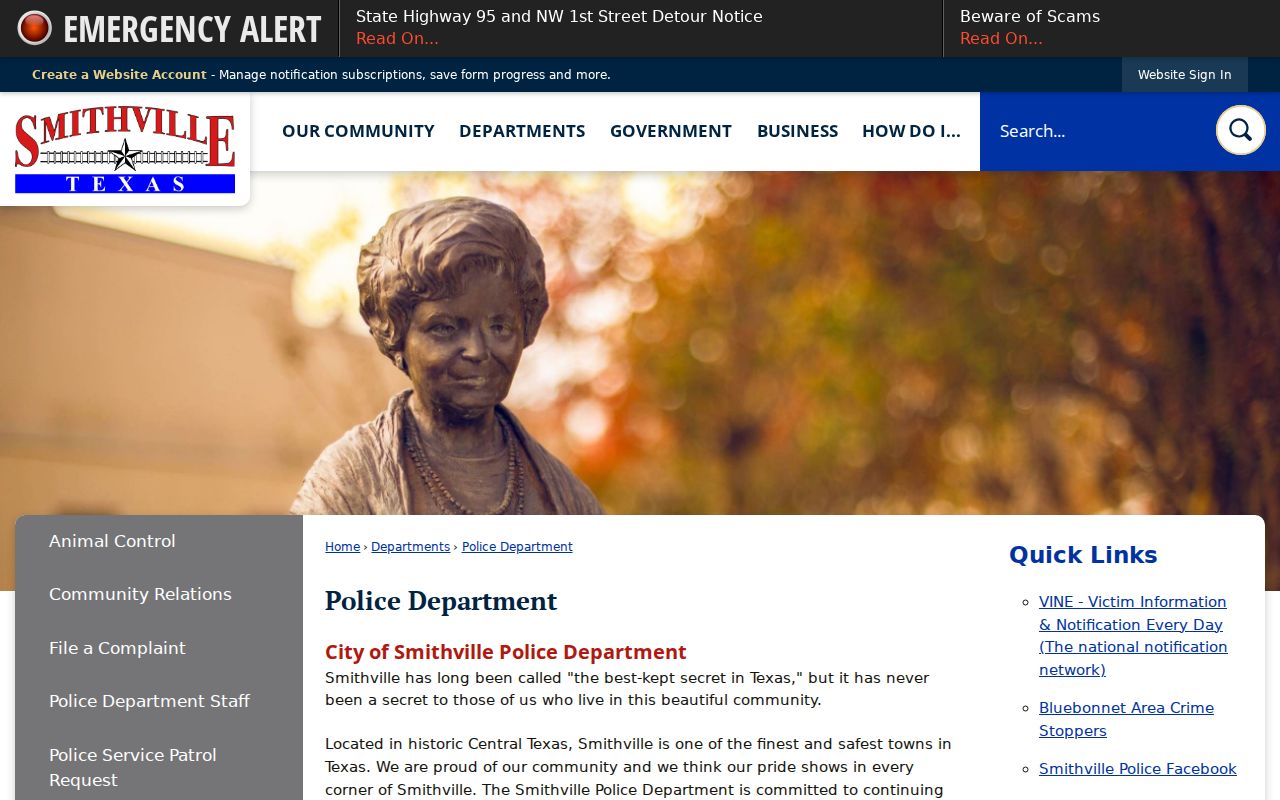
Smithville Police Department Records
Smithville Police Department uses City Hall at 317 Main and P.O. Box 449, Smithville, TX 78957. City Hall is open weekdays from 7:30 a.m. to 5 p.m. and uses 512-237-3282. A request should identify an existing incident, arrest, or other police record.
Police custody does not guarantee full release. Active investigative facts, victim information, identifiers, juvenile material, and records covered by a court order may be limited. Ask for the public part and let the custodian state the basis for any redaction.
The official department page provides the local agency context.
A CR-3 crash report uses the state crash system rather than the general Smithville police-file route.
Three Smithville Request Details
The optional form reinforces three core details: a name, reliable contact information, and a clear description. Add dates, a location, report type, and known case or incident number when available. These facts narrow the search without asking Smithville staff to create a report that does not exist.
Email can be fast, while mail and in-person delivery create a clear paper trail. Fax is also valid when marked for the police records custodian. Phone can clarify office procedure, but it does not count as the request itself.
Smithville Arrests and Bookings
No official Smithville arrest blotter or city detention roster was found. Smithville Police fingerprints a reportable arrest, assigns and sends the transaction number, and county staff receive the CR-43 information. The county then enters that tracking number in its jail system without a duplicate submission.
The Smithville police report and county booking are separate records. A filed misdemeanor or felony case adds a third source. The Bastrop County arrest lookup covers county custody when Smithville request cannot answer where someone was booked.
Smithville Citation Contact Deadline
A person cited by Smithville Police must contact Municipal Court within ten working days. That deadline is a court-response rule, not a public-record turnaround. Contact the Smithville clerk at 512-237-3282 option 4 or by mail at P.O. Box 449.
Do not let a vendor payment screen stand in for court contact. A case can require a plea, setting, or other response. Confirm the citation with the Smithville clerk, learn the available choices, and preserve Smithville Municipal Court's record of the response.
Municipal Court Records in Smithville
Smithville Municipal Court operates through City Hall. It handles traffic, ordinance, and fine-only city cases. The vendor named on Smithville page takes payments but is not a proven complete public docket. A clerk inquiry remains the best fallback for the citation, plea, settings, and disposition.
| Court Name | Smithville Municipal Court |
|---|---|
| Case Types Heard | Traffic, ordinance, and fine-only Class C matters |
| Case Lookup Channel | Court clerk inquiry; payment vendor is not a complete docket |
| What the Docket Shows | Citation, plea, settings, payment, and disposition held by Smithville Municipal Court |
| Copies & Fees | Ask the Smithville clerk for current record-copy terms |
Smithville Payment Is Not a File
The Smithville court page lists several payment routes. In person, cash, check, money order, and card are accepted; cards cost 3.5 percent plus $0.25. Phone cards use the same fee. Mail takes money orders or cashier checks. A drop box sits left of the City Hall door.
The official court image puts the options in their city context.
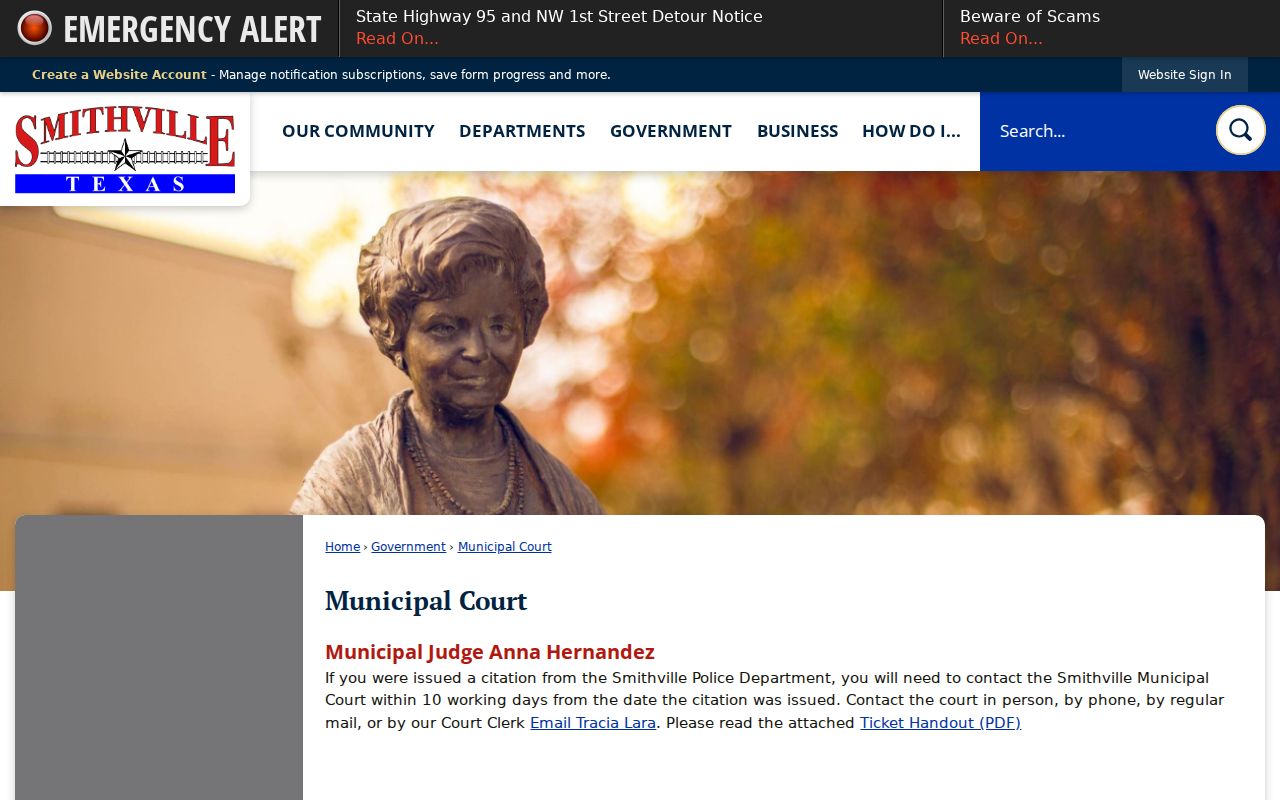
Online card payments cost 3.5 percent plus $0.25 and ACH costs $1.99. The vendor phone line charges 6.5 percent. Those are payment fees, not record-copy fees, and the vendor is not Smithville case file.
Where Smithville Records Go
Smithville Police creates an arrest report and fingerprint event. County jail staff connect the transaction number to booking. Prosecutors decide what charge to file, and clerks report court action. Texas DPS receives the reportable stages for CCH. A recent Smithville event may therefore exist before a state name search reflects it.
Record flow: Smithville Police Department › Bastrop County Courts › Texas Department of Public Safety
The 2024 workflow lists 27 SPD charges, 13 prosecution actions, and three court actions. Those figures measure reporting stages, not offenses or the number of people. Each count answers a different records question.
Statewide public CCH does not contain every Smithville police contact or local case. It shows the public Texas conviction and deferred-adjudication subset that agencies have reported. A recent arrest can remain visible only in local police or county booking records before a prosecutor files anything. A dismissal may appear in Smithville Municipal Court file without becoming part of the public DPS product. For your own history, fingerprint review is stronger than a name match.
Smithville Cold-Case Record Milestone
An official 2025 Texas DPS release credited Smithville Police, the Sheriff's Office, District Attorney, Texas Rangers, laboratories, SAKI, CODIS, and genealogy work in resolving linked older assaults. The institutional milestone shows how a Smithville report can gain records from many agencies over time. It should not be reduced to one local police file.
For an older matter, identify the document sought and the likely custodian. Smithville Police may hold its report, while a court or state lab record belongs elsewhere. Protected victim details remain subject to law even when the case has broad public importance.
Smithville Records and Rail History
Smithville settlement is linked to Dr. Thomas Jefferson Gazley in 1827. The Missouri-Kansas-Texas line took over the rail route in 1891 and placed central shops here in 1894. The growth made Smithville the county's largest city for nearly fifty years. Older records may thus require more than a modern web search.
For current crime statistics, select Smithville Police in the official FBI Crime Data Explorer. Keep those figures apart from DPS workflow counts and court results. An offense report, arrest, booking, and disposition measure distinct events.
Older Smithville research benefits from a precise date range and record type. Rail-era history will not appear in a payment vendor, and a modern police portal cannot be assumed to index archived court material. Ask which custodian holds the series and whether the item has been imaged. A blank online response is only a search result, not a finding that the source record never existed.
Modern local programs can also create records outside the criminal-history stream. CodeRED notifications and bicycle registration serve public-safety goals, but they are not criminal lookups. Their existence reinforces the need to name the exact Smithville record sought and avoid sweeping requests for every piece of data tied to a person.
Public Access Rules in Smithville
The Texas Public Information Act governs existing Smithville city records. It allows access while preserving law-enforcement exceptions and privacy protections. Identifiers, victim and juvenile material, sealed records, and expunged or nondisclosed data may be restricted. Municipal Court files also follow judicial access rules and court orders.
Smithville makes the first access rule plain: a police request must be written. Keep the email, fax confirmation, mailed copy, or in-person receipt. If the custodian asks for a clearer scope, add the incident date, location, report type, and known number. The optional city form is useful but not stated as mandatory, and the research found no posted police copy fee, identification rule, or fixed turnaround. Do not import terms from a county or neighboring city. Ask Smithville for the releasable part of the exact existing file and retain the written response that explains any redaction.
Record custody then sets the next route. Smithville Police owns its incident and arrest report. Bastrop County owns the county booking record. Smithville Municipal Court holds city citations, pleas, settings, and dispositions. County clerks maintain higher-level prosecutions, and Texas DPS maintains the reported CCH layer. The same transaction number can help link the arrest and booking without making those sources interchangeable. A booked charge can change before filing, and a filed charge can end in dismissal, acquittal, deferred adjudication, or conviction. Read each Smithville record for the stage it actually documents.
The payment vendor creates a further boundary. Its card and ACH screens are ways to send money, not a proven full public docket. Card, phone, mail, drop-box, and vendor fees describe payment channels rather than record-copy costs. Contact the Smithville clerk within ten working days of an SPD citation and confirm the required response. A vendor receipt proves payment, while the court file proves the citation's procedural history and outcome. A missing online balance does not show that the case was dismissed, sealed, or never filed.
A Smithville response may release a redacted record rather than an all-or-nothing file. Keep a copy of the written request and proof that it reached Smithville. If the description was too broad, narrow the date, event, and document type. If Smithville names a different custodian, route the next request there. Police staff cannot supply a county clerk's case file or a DPS history merely because the events began in Smithville.
Municipal Court access runs through its clerk. County booking information runs through Bastrop County. The Texas Department of Public Safety controls CCH. Those boundaries help explain why one search can be blank while another source holds a valid record. They also protect against blending a report, arrest, booked charge, filed case, and conviction into one unsupported conclusion.
Key Statutes:
Texas Government Code Chapter 552 grants access to public information subject to stated exceptions.
Texas Code of Criminal Procedure Chapter 66 links arrest, prosecution, court, and supervision reporting.
Texas Government Code Chapter 411 controls CCH dissemination and nondisclosure.